

Influence of nitrogen fertilizer rates on forage yield and nutritive value of a cover crop cocktail blend
Annual forage-type crops are an integral part of the feeding regimes of beef cattle operations in the Peace Region. When mixed as cover crop cocktail blends, these species not only provide high-quality forage but also play a key role in providing ecosystem benefits, including enhanced nutrient cycling, biological N2 fixation, soil moisture conservation, and carbon sequestration within cropping systems. This study looks at how different nitrogen rates affect forage yield, feed quality, and water-use efficiency of a producer-designed cocktail blend.
What We Did
The project was implemented at the Fairview Research Farm (NW-5-82-3 W6) located on RR # 35, MD of Fairview, Alberta, in 2025.
Experimental design was a randomized complete block design (RCBD) using three replications in small plots measuring 8 m x 2 m.
Table 1 captures the site history, field operations performed, and data collected.
Table 1: Field operations and data collection

Field Observations During The Growing Season
The site received about ½ inch of rainfall a week after seeding. This ensured the proper emergence of some treatments. The site received a total of 4.5 inches of rainfall throughout the growing season.
All CDC Haymaker Oats with or without N applications performed better than the CCCs.
About 4 weeks into the season, a dry spell hit the site, causing plants to stunt. This affected the overall performance of forage plants. However, the CDC Haymaker Oats continued to grow vigorously.

Producer- designed Cocktail with 0% N rate
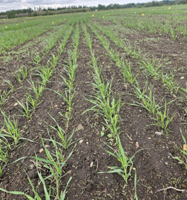
CDC Haymaker oats with 0% N rate
Figure 1. Germination after 3 weeks of seeding.
Results and Implications

Forage Dry Matter (DM) Yield
We found differences in DM yield among treatments (Table 1). The CDC Haymaker Oats (0% N) had the highest yield (2,399 lb/ac) followed by both CDC Haymaker Oats at 100% N and 50% N, with similar Forage DM yields. The CCCs with 50% N and 100% N recorded similar but the lowest yields. Overall, the CDC Haymaker Oats and CCC without N fertilizer applications had higher yields compared to those with 50% N and 100% N fertilizer. Our results have an economic implication on the decisions of producers when choosing options of quantities of N application with cocktail blends at seeding. This could help cut down the costs of operations and improve the total revenue of producers.
Nutritive Values
Crude Protein (CP): There were variations in CP among forage treatments with N rates ranging from 12.2 – 13.7%. The CDC Haymaker Oats (100% N) produced the highest CP (13.7%), whereas the CCC without (0% N) and with 50% N recorded the lowest. All treatments produced acceptable CP requirements for mature beef cows. Adequate CP facilitates rumen microbial activity, allowing proper digestion and nutrient absorption. A lower CP (7-8%) slows down digestion, causing cattle to eat less.

Photos of field season activities

Hand weeding during the Summer
Total Digestible Nutrients (TDN): There were no differences in TDN among treatments. However, they ranged from 66.6% for CCC + 100% N – 67.4% for CDC Haymaker oats (0 and 100% N). Sufficient energy in forages is essential for body temperature maintenance, particularly in extreme cold conditions.
Acid Detergent Fiber (ADF) and Neutral Detergent Fiber (NDF): No differences were found in ADF and NDF among the forage treatments. The ADF ranged between 33.9-34.4% while NDF ranged between 48.5 – 49.1%. The CCC with 0% N and 100% N had the lowest ADF and NDF, respectively. A lower ADF and NDF is critical for better forage intake and digestibility. Thus, it is important to supply cattle with forages which are less bulky and can easily be broken down by ruminal microbes, ensuring better energy release to cattle.
Neutral Detergent Fiber Digestibility (NDFD 48 hr): Digestibility after 48 hr showed no differences among forage treatments with or without N rates. In nominal values, CCC with 100% N recorded the lowest digestibility, while CDC Haymaker oats (100% N) had the highest.
Phosphorus (P), Calcium (Ca), and Potassium (K): No differences in P, Ca, and K were found among forage treatments. Overall, P concentration ranged between 0.25 - 0.27%, Ca between 0.85 - 0.93%, and K between 1.28 - 1.37%. Forages which contain the right nutrients in the right amounts could nourish cattle and improve their overall performance, vice versa. Those forages with inadequate nutrients require mineral supplementation, which is an additional cost, increasing the production expenditure.

There were differences in WUE among forage treatments. The CDC Haymaker Oats without N application had the highest WUE (56.8 lbs of DM in-1), while the lowest was recorded in the CCC, which had 50 and 100% N application (20.7 and 20.9 lbs of DM in-1, respectively). Overall, treatments under either CDC Haymaker Oats and CCC without N application had higher WUE than those with 50 and 100% N applications (Table 4). Understanding the water use efficiency of these crops is important for selecting crops for areas which experience lower seasonal precipitation, such as the Peace. Our findings suggest that CDC Haymaker Oats captured soil moisture for better yield, making it resilient in adverse conditions.
Conclusion
CDC Haymaker Oats without N applications had the highest water use efficiency, hence yielded more than the producer-designed cocktail (CCC), irrespective of the N rates.
While high CP was recorded in CDC Haymaker Oats, in nominal values, the producer-designed cocktail had the lowest ADF and NDF advantage.
Forage treatments had similar TDN, NDFD-48 hr, Ca, P, and K concentrations.
Overall, N application rates did not significantly improve forage yield and quality.

Plots during mid-June before harvesting

Harvesting plots


Comments